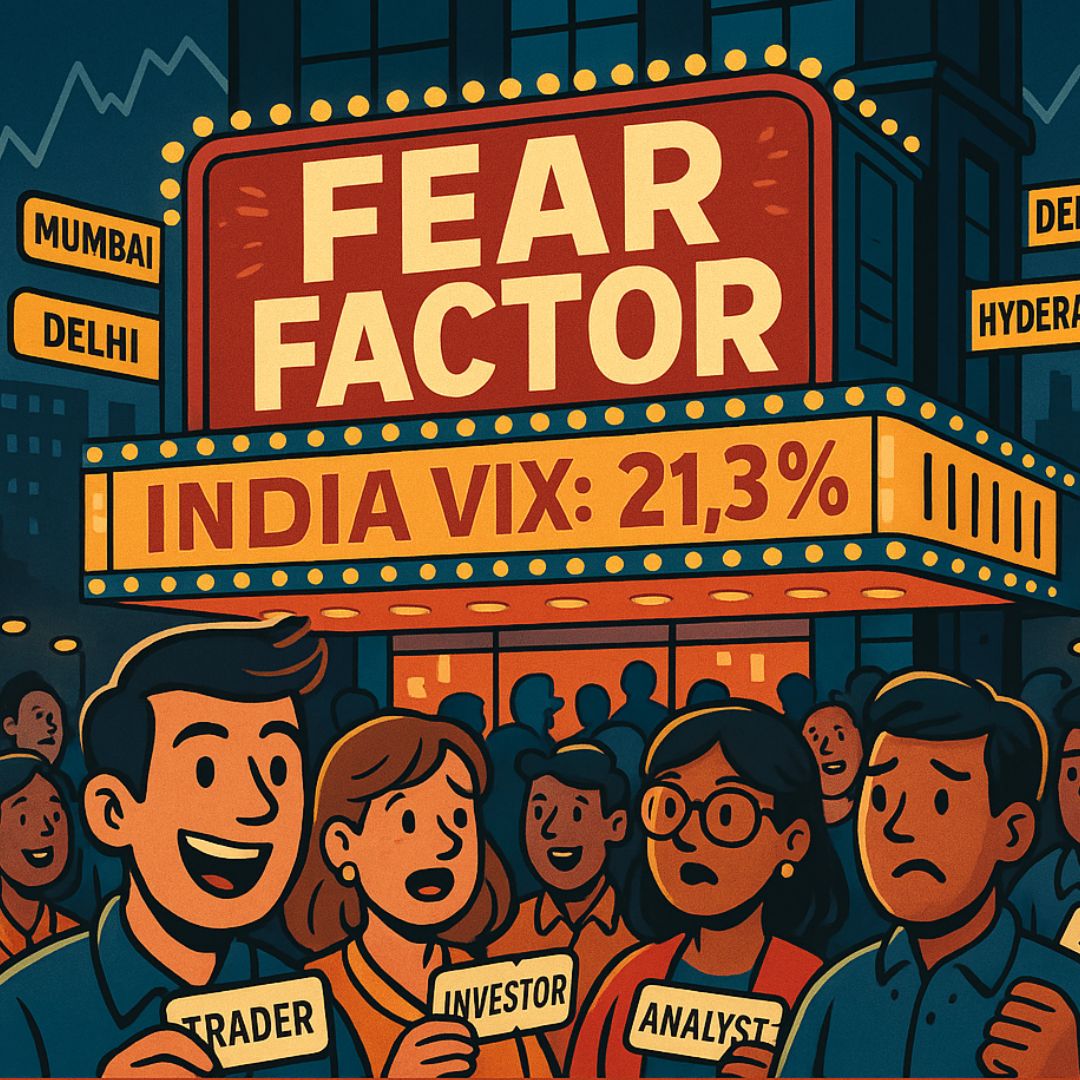
Monday 9 a.m. Priya is at a financial theatre, in Mumbai, named Dalal Street. The screen shows a pre-show advertisement on a heart-pulse rate monitor. She has booked the ticket for the movie named ‘Fear Factor’ and the show will start at 9.15 a.m.
Sudha is at a financial multiplex plaza, at Bandra Kurla Complex in Mumbai. She is so thrilled to watch the newly released movie ‘Fear Factor’ and waits for the show to start at 9.15 a.m. Now, she is bored of the advertisement that blares on her screen on Pulsometer that accurately captures one’s pulse, including joy, fear, anger, and so forth.
Theatre India… Delhi, Jaipur, Kancheepuram, Shimla, Ahmedabad, Srinagar, Chandigarh, Hyderabad, Bengaluru, Chennai, Port Blair…
People throng the theatres to watch the ‘Fear Factor’ movie. At length and breadth of the country, the first day first show releases at 9.15 a.m. During the previous two days, people have heard loads of reviews through newspapers, TV channels, research reports, expert discussions and what not. All eyes are on ‘Fear Factor’ and the movie is on everyone’s lips. Even a few minutes after the opening, one could judge whether the movie could create a lasting impact on the viewers. Will it create fear, will it have a lasting impact?
9.15 a.m. Screens across started flashing numbers in greens and reds. Priya jumps with joy. Sudha hits her head with hands, in grief over loss. In a similar vein, mixed reactions from viewers could be seen at Theatre India. Adrenalin rush in a few viewers, cortisol rises in some, some are fearful, some are in panic, some curious, some puzzled, some happy, some calm and collected, some bored, some relaxed, some nervous, some anxious, some drumming the seat in tension… not just Nava Rasas, ‘N’ number of rasas grip people’s faces. Across Theatre India, viewers feel electricity in the air.
Now, it’s easy peasy to check how Priya and Sudha feels individually. Whether they are happy, fearful, or are they in grief. But, if you want to capture the collective moods of all viewers at Theatre India, from all regions, that is humanely impossible right? What if I tell you that’s absolutely possible through a magical and numerical device.
Let’s step out of the Mumbai theatres and Theatre India and try to connect the dots. The theatres aren’t the real theatres but stock markets (BSE & NSE) indeed. The movie ‘Fear Factor’ is the actual trading day that starts at 9.15 a.m. Sudha, Priya and other viewers are not the movie viewers but in fact they are traders. The movie reviews on the newspaper reports, TV channel discussions are nothing but the market predictions during the previous day. The ‘N’ number of Rasas are nothing but the actual feelings and reactions of the traders across the country.
So, now, what is the device that could capture the collective mood of the market. The devil/divine device is named India VIX. It doesn’t measure the BP or heart rate of individual traders; it doesn’t measure the temperature of the trading room individually. Instead, it measures something subtle and collectively - Mood of the market/traders, as one unit in one shot. It is designed in such a way that it senses the collective anxiety/fear of every participant, every trader or every investor in the market. This is crucial because in the world of bourses, how people feel and react matters a lot.
What is India VIX?
India VIX is the short form for ‘Volatility Index’ of Indian stock markets. India VIX measures the expected annual volatility in the securities market, but over the next 30 days. India VIX is popularly known as ‘Fear Index.’ The name has a reason – the VIX digit represents/measures the level of fear, stress or risk that might grip the market in the next 30 days. It may not be exaggerated if I say that India VIX is the country’s first volatility index that measures the market’s expectations of the near-term volatility. It helps traders/investors understand how much the market will likely fluctuate in the next 30 days.
India VIX doesn’t predict whether the market will be bullish or bearish on the said trading day. Instead, it measures how hopeful/joyful people feel about the market's performance in near future, especially in the next 30 days. Like a weather forecast that predicts cyclones and heavy downpours, India VIX is the financial weather forecasts that predicts financial Sunshine, rains, storms or cyclones.
Just as how people check the weather before leaving home and decide upon whether to take umbrellas or raincoats, seasoned traders and veteran investors check the digits of India VIX before diving into actual trades, be it small or big.
Origin of VIX
Chicago Board Options Exchange (CBOE) created VIX in 1993 and so it is popularly known as CBOE VIX. The CBOE VIX is based on Options contracts of the S&P 500 Index for the next 30 days. In 2008, the National Stock Exchange (NSE) of India introduced India VIX, following the footsteps of CBOE.
India VIX is an index that represents expected annual volatility in Nifty50 over the next 30 days. Being the sole indicator to measure the volatility, it reflects investors' mood/sentiment about the market in the next 30 days. Just as CBOE VIX tracks S&P 500 Options contracts, India VIX tracks Option contracts of Nifty50 for the next 30 days.
How India VIX is computed?
The calculation of India VIX is not based on stock prices or market indices. Instead, it is a value derived from the order book of Nifty Options contracts using the Black-Scholes model. The model includes strike price (Option exercising price), Current Market Price of the Nifty index, Expiry time (measured in minutes for precision), risk-free interest rate (for a tenure of 30-90 days), forward index level (determines "at-the-money" strike price) and volatility, that is, key variables representing the fluctuations in the market. To compute the India VIX, which is expressed in percentage, the best bid-ask quotes of near-month and next-month NIFTY Options contracts (traded on the NSE's F&O segment) are used. For the strikes that do not have appropriate quotes, values are derived at by using interpolation, with the help of a statistical method known as ‘Natural Cubic Spline.’ Let’s not get into too many technicalities of the calculation part.
How to interpret India VIX?
India VIX is a crucial tool for diverse market participants including intraday traders, Options traders, portfolio managers, Mutual Fund managers and even long-term investors. Before proceeding to understand the interpretation of India VIX, one must understand that while Nifty tracks fluctuations in stock prices, India VIX measures market volatility. Further, the index Nifty50 and India VIX are negatively correlated. That is, when India VIX rises, Nifty50 goes down owing to increased uncertainty and while India VIX falls, Nifty50 rises, owing to the level of confidence in market stability.
If India VIX is less than 15, it means the market is stable and calm with low volatility. With this, traders would not expect much price swings on either side. If India VIX is above 15 and within 20, it means the market has moderate volatility, which is the moderate range for Indian securities market. If it’s above 20, this signals a high volatile market, and one can expect significant price fluctuations. Traders/investors might be fearful/uncertain about the course of the market and there might be larger price swings. If India VIX jumps to 30 or above, alarm bell is triggered. That is, traders expect something huge, maybe a crash or maybe a crazy rally. In short, the higher India VIX indicates higher market volatility and a lower India VIX indicates less volatility.
One cannot predict the direction of the market with the help of India VIX but can sense the heat of the market, either good (rally) or bad (crash). Traders are extremely fearful, and they are extremely uncertain about the market behaviour.
Let’s understand this deeper. Say for instance, the current day’s Nifty50 closed at 24950 and India VIX on that day was at 11%. This means, based on Nifty50 Option contracts for the next 30 days, the expected annual volatility is 11%, either on upside (bullish) or on downside (bearish.) Therefore, the annual expected fall would be 24,950 – 11% = 22,205 (approximate) and the annual expected rise would be 24,950 + 11% = 27,695. Therefore, Nifty50’s expected statistical range (annualised) for the next year would be between 22,200 to 27,700 (rounded off.)
In a nutshell, India VIX is the magical device that captures the entire mood of the market or the pulse of Mr. Stock Market. It signals stress, uncertainty or even fear of Mr. Stock Market.
Cheers! Catch you later with another interesting and informative episode. Until then...