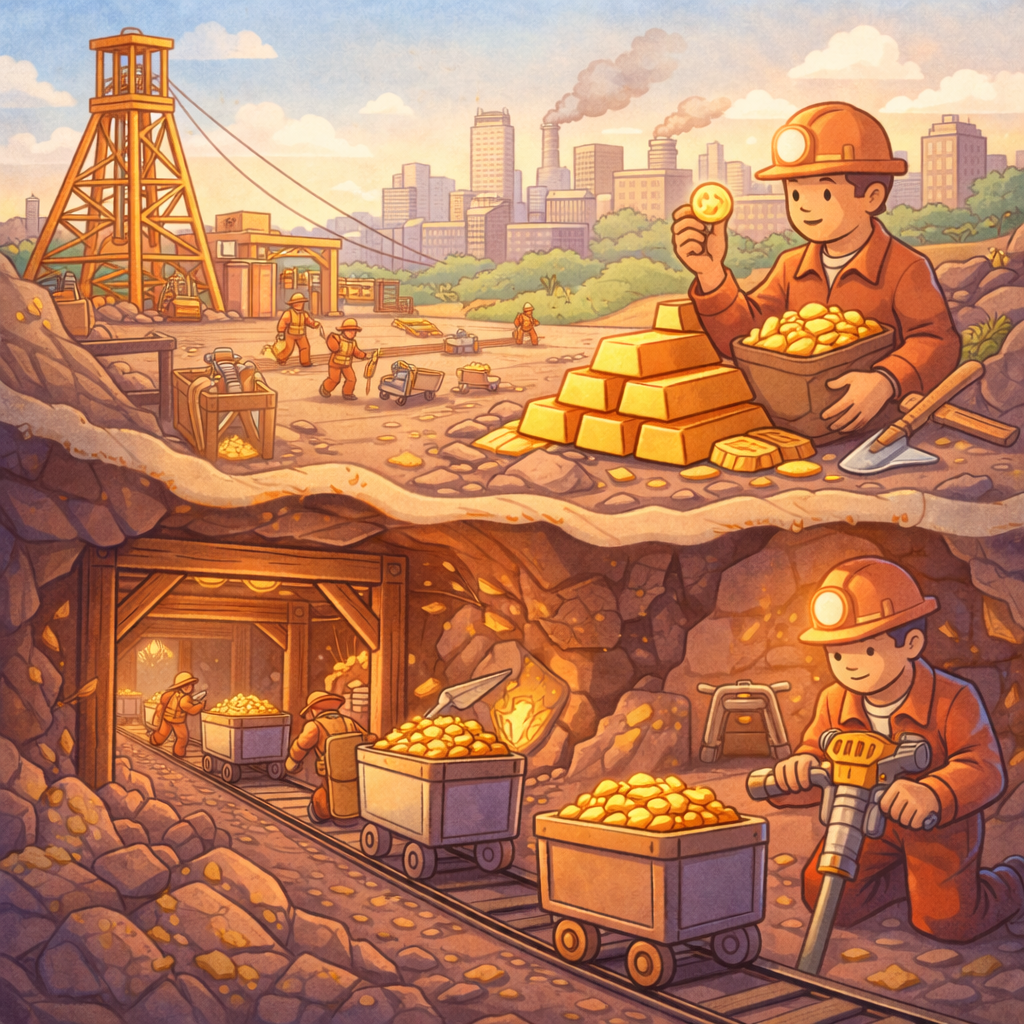
The golden womb What was once farmland quickly transformed into a landscape of mines and settlements, drawing people from across the world. Unlike El Dorado, Johannesburg's ascent began not with a legend or imagination, but with the 1886 discovery of the Main Reef in the Witwatersrand Basin, an event that transformed the global pursuit of gold.
In contrast to the fleeting rushes of the past, the Witwatersrand revealed a vast banket of gold-bearing conglomerate rock stretching for miles, a geological formation so extensive that it would eventually yield nearly 40-50% of all the gold ever mined. This discovery transformed the Transvaal highveld, the high plateau of South Africa, where open land was quickly carved into deep mining shafts and expanding settlements, giving rise to what would later become Johannesburg.
Johannesburg emerged as a city of gold, known as Egoli, built on a scale previously unimaginable, shifting the story of gold from chance discovery to organised extraction. Here, gold was no longer a stroke of luck. It was hunted beneath the earth, measured in hidden veins, and brought to the surface from the depths, through relentless precision and persistence.
From dust to iron
The growth was sudden and unrelenting. Within a decade, a population of almost nothing swelled to over 100,000. What began as Ferreira's Camp, a scattered cluster of prospectors, quickly turned into a global magnet. The Transvaal highveld filled with the voices of Uitlanders (outsiders or foreigners), as Cornish miners (from Cornwall), Australian diggers, and fortune-seekers from as far as California converged with thousands of African labourers drawn into the new cash economy.
There was little time for planning. The canvas settlement of 1886 soon gave way to corrugated iron and red brick, as structures rose as quickly as the demand for gold. Known as Randjeslaagte, this triangular stretch of land did not wait for order. It expanded in response to what lay beneath, evolving from a mining camp into the growing financial centre of Southern Africa.
Building the underworld
As the surface deposits were exhausted, the search for gold turned into a battle with the earth itself. Johannesburg did not just grow outward; it grew downward. Beneath the city, a vast underground world took shape, a network of shafts and tunnels plunging kilometres into the rock. This was not the search for scattered nuggets, but the extraction of gold locked within stubborn layers of conglomerate, requiring heavy machinery to crush and chemical processes to refine. The deeper the mines went, the harsher the conditions became, with rising heat and pressure testing both men and machines. Above ground, the skyline filled with headgear and towering mine dumps, while below, the city extended into darkness. This was no longer a gold rush. It was a gold industry, operating round-the-clock with relentless scale and precision.
But this vast underground world came at a cost. The work was dangerous, demanding long hours in heat, dust, and confined spaces deep beneath the earth. Miners faced constant risks from rockfalls, equipment failures, and the strain of working at extreme depths. Thousands of labourers, many drawn from across Africa, powered this industry under harsh conditions, often for minimal wages. The gold that rose to the surface carried with it not just value, but the weight of human effort and sacrifice.
The scale of this discovery did more than build a city; it reshaped the global economy. As the gold of the Witwatersrand proved vast and consistent, Johannesburg emerged as one of the world's most important centres of gold production. Capital flowed in from across the world, and what began as a mining settlement grew into a hub of finance and industry. Every ounce of gold brought to the surface strengthened its position in global markets, linking the city to financial centres far beyond its borders. Johannesburg was no longer just a place where gold was found. It became a place where wealth was produced, measured, and circulated on a global scale.
A city built on gold
Today, Johannesburg remains the urban heart of the Witwatersrand Basin, a geological formation that has yielded over 1.5 billion ounces of gold, nearly half of all the gold ever brought to light. While the fever of 1886 has cooled, the city's foundations remain both literal and figurative. Some of its deepest mines, such as Mponeng Gold Mine, extend more than four kilometres beneath the earth's surface, where temperatures can exceed 60°C.
As the cost of ultra-deep mining increased, the city's engine shifted, evolving into Africa's leading financial hub, where the Johannesburg Stock Exchange now trades in capital rather than ore. Yet the physical memory of gold remains unmistakable. The skyline is still marked by large mounds of mining waste, pale yellow heaps of sand left behind after gold extraction, standing as silent and often toxic reminders of a century of mining.
The gold may lie deep beneath the earth, but its imprint remains above it, in the shape of a city that rose faster than it could understand itself. In Johannesburg, gold was no longer imagined or discovered. It was taken from the earth, leaving behind a city that still carries both its wealth and its weight. Part-3 turns to Rome and Dubai, where gold was no longer unearthed, but controlled and accumulated. These cities did not extract gold, but commanded it, turning wealth into power and display.
Until then, cheers...